A course is on sale. The reviews look good, the certificate has a familiar logo, and the checkout button makes learning a new skill feel like a decision you can finish in thirty seconds.
Then comes the harder part: finding time to study, getting stuck on the exercises, and figuring out whether any of it belongs on your resume.
So, are online course certificates worth it? They can be, especially when the training solves a specific problem or the credential matters to your target employer. But paying for a course and becoming more capable are two different milestones.
My advice is to evaluate the learning, the assessment, and the credential separately. A course can teach you something valuable even when its certificate has little recognition. A familiar certificate can also be a poor purchase if it covers skills you already have.
Here’s how to decide before you spend your money.
Table of Contents
Course Certificates vs. Professional Certifications
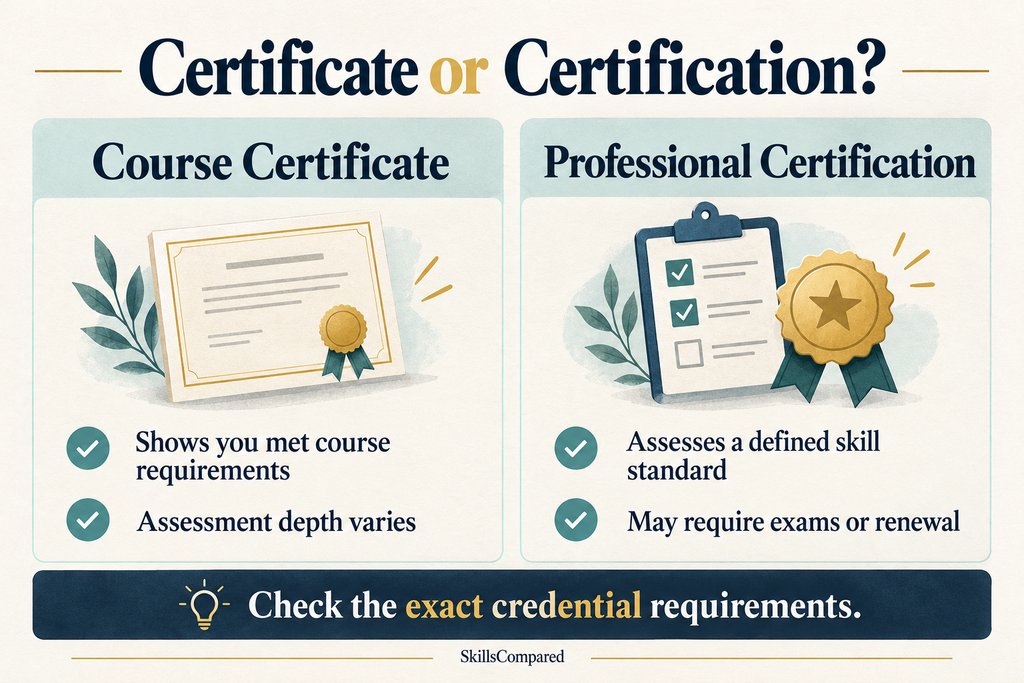
A course certificate generally records that you met a program’s completion requirements. Those requirements might include watching lessons, passing quizzes, completing projects, or submitting assessed work. The certificate alone doesn’t tell you how demanding that process was.
A professional certification generally assesses knowledge or competence against a defined standard. Depending on the credential, it may involve an exam, experience requirements, renewal, or continuing education. The exact rules matter more than the label. Coursera’s explanation of certificates and certifications
An exam-preparation course and the exam itself can also be separate purchases. Before enrolling, check what you earn, who issues it, and whether any exam fee is included.
The word “professional” in a course title doesn’t automatically make it equivalent to an independently assessed industry certification.
What Are You Really Paying For?
The certificate is the easiest part to display, but it may not be the most valuable part of the purchase.
A structured learning path. Free tutorials can answer individual questions beautifully. The difficulty is deciding what to learn next. A well-designed course gives you a sequence, explains prerequisites, and builds toward a usable result.
Practice and feedback. Look closely at what learners actually do. A multiple-choice quiz, an automated coding test, peer feedback, and an instructor reviewing your project are different experiences. Check which one the price includes.
Accountability. A timetable or study group may help you keep going. Buying access alone doesn’t create study time, though. Put two realistic sessions on your calendar before you subscribe.
A credential someone values. Recognition depends on the exact program, role, employer, and market. A recognizable company name is a starting point for investigation, not proof that every course it offers carries the same hiring value.
I would start with a simple question: if the certificate disappeared, would the course still help me achieve my goal?
If the answer is no, find out precisely why the credential matters before paying for it.
When Online Course Certificates Are Worth It
When you’re changing careers. Relevant training can help explain your transition and give you material to practice. Imagine a customer-support worker exploring UX design. A documented usability study would make the learning easier to discuss than a course title alone.
That example doesn’t guarantee interviews. It shows how training can support a clearer application: here’s what I studied, here’s what I tried, and here’s what I learned from the results.
When a role asks for the exact credential. Read recent job advertisements for positions you would realistically apply to. Record the precise certification names, required skills, and experience expectations. Don’t substitute a similarly named course for the qualification an employer actually requests.
When you need an organized route through a subject. A beginner who keeps switching between tutorials may benefit from a coherent syllabus. The value is having a sensible next step and opportunities to practice it.
When your employer supports the training. Ask whether there is a learning budget, which programs qualify, and whether approval is needed before payment. Also clarify whether your manager expects an exam result, a completion certificate, or evidence that you can apply the skill.
When it strengthens work you can already show. A marketing course paired with an original campaign plan gives you more to explain. Include your audience, assumptions, budget, and how you would judge success. Clearly label hypothetical results rather than presenting them as real campaign performance.
When a Certificate May Not Be Worth the Cost
The weakest purchase is one made without a clear purpose. A discount can make a course affordable without making it relevant.
Be cautious when the syllabus repeats what you already know. An introductory course can be well taught and still be the wrong level for you.
Also investigate unfamiliar issuers. An independent instructor may teach exceptionally well, so an unknown name doesn’t make the learning worthless. It does mean you should assess teaching quality and credential recognition separately.
Watch for promises that depend on fine print. If a provider advertises a job guarantee, check eligibility, application requirements, deadlines, exclusions, and the remedy offered. A conditional refund policy is different from a promised job offer.
Finally, check whether the course is current enough for its subject. Older material can still explain durable concepts well. A lesson on a tool’s interface or certification exam objectives needs closer checking against the version you will use.
Free vs. Paid Courses: What Actually Changes?
Price doesn’t reliably tell you how much practice, feedback, or useful instruction you will receive. Compare the specific offers.
| What to compare | Free option | Paid option |
|---|---|---|
| Access | May include a full course or a limited preview | May be time-limited, subscription-based, or a one-time purchase |
| Structure | Can provide a complete learning path | Check the syllabus rather than assuming it is better |
| Practice | Projects and exercises may be included | Verify the depth and originality of assignments |
| Feedback | May use automated checks or community support | Instructor feedback is not automatically included |
| Certificate | May be included, optional, or unavailable | Confirm whether the advertised price includes it |
| Career relevance | Depends on the skill and credential | Still depends on the skill and credential |
For coding, freeCodeCamp provides free learning resources and certifications. For marketing and sales topics, HubSpot Academy offers free training and certification options. Read the requirements of the particular program you choose.
YouTube can also be useful for a narrow task, such as understanding a spreadsheet function. If you use separate tutorials, keep your own checklist so you know which topics and exercises remain.
One important update: Coursera announced that its preview model replaced the previous audit experience, allowing a free first-module preview for most courses. Don’t assume an entire course is available free without its certificate. Its financial aid can provide free or reduced-cost access for eligible learners; it is not a universal promise of a free program. Coursera’s preview and financial-aid announcement
Six Checks Before You Pay for a Course
Use these checks to compare a shortlist. You don’t need a complicated scoring spreadsheet, but you do need answers more specific than “it looks good.”
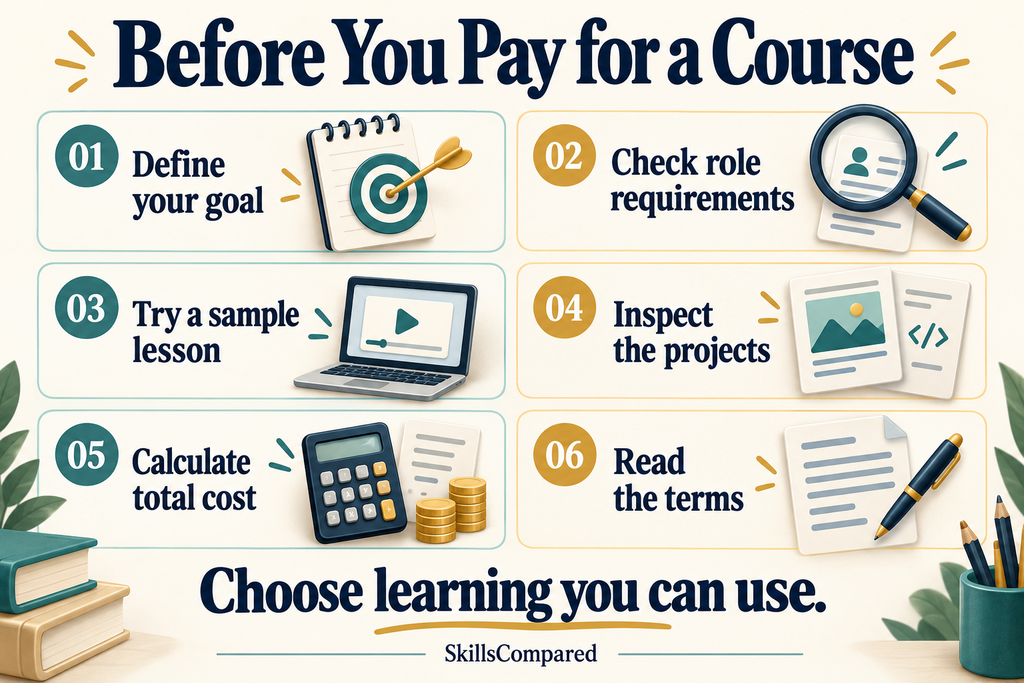
1. Define your goal. Replace “learn data analysis” with something you can demonstrate: “clean a sample sales dataset and explain monthly trends.” If you cannot identify a starting point yet, try introductory material before committing to a long program.
2. Check role requirements. If employment is the goal, review 10–15 relevant vacancies. Look for repeated skills and exact credential names. A job advertisement is evidence about that role, not a guarantee that completing a course will qualify you.
3. Try a sample lesson. Use whatever preview the provider currently offers. Pause the demonstration and attempt the exercise yourself. Notice whether the instructor explains mistakes and whether the prerequisites match your background.
4. Inspect the projects. Look for work that requires decisions, not just copying a finished example. Ask whether anyone reviews it, how feedback is delivered, and whether you may share your work publicly.
5. Calculate the total cost. Suppose a subscription costs $49 a month. Six paid months would be $294 before taxes or extras. That’s an illustration, not a quote for a particular course. Include exam fees, software, renewals, and the realistic time you have available.
A 40-hour workload at four hours a week takes about ten weeks, before allowing for missed sessions or extra practice. Budget for that schedule rather than an ideal weekend that never arrives.
6. Read the terms. Check cancellation, refund eligibility, access duration, and financial-aid conditions on the provider’s current pages. Don’t treat a refund policy as an unrestricted free trial. Save the offer and conditions that apply to your purchase.
For a concrete example of evaluating an introductory program, our Google AI Essentials review covers its curriculum, pricing model, and intended audience.
How to Turn a Certificate Into Evidence of Skill
Before enrolling, complete this sentence: “After this course, I want to be able to ___.” Then decide how you will test that ability.
For a practical course, a small original project often works well. After spreadsheet training, you could build an expense summary from fictional transactions. Document how you handled missing categories, checked totals, and chose the charts.
For a conceptual subject, a thoughtful explanation, critique, or set of solved problems may be more appropriate. Not every worthwhile course needs a GitHub repository.
Keep a short record of your process:
- What problem were you addressing?
- What choices did you make?
- What went wrong, and how did you investigate it?
- How did you check the outcome?
- What would you improve next time?
On your resume, use the credential’s exact name and issuer. Include relevant coursework where it helps explain your preparation, and avoid describing course completion as a professional license or a different certification.
There is no universal limit of one or two certificates. Select what is relevant to the role and the space available. If the list pushes stronger evidence off the page, shorten it.
You can share a learning example on LinkedIn, too. Describe something specific you understood or improved. Don’t invent engagement figures, client results, or claims that a post attracted recruiters.
Frequently Asked Questions
Can an online course certificate help me get a job?
It can contribute to an application when relevant, but it doesn’t replace every other requirement. Consider the employer’s requested experience, skills, assessments, and qualifications. Practical examples can help you explain what the training taught you.
Is a Google certificate worth it?
Evaluate the exact program. A short introductory course and a longer career-focused program serve different purposes. Compare the syllabus, workload, assessment, and total cost with your goal instead of treating all Google credentials as interchangeable.
Should I put Coursera or Udemy courses on my resume?
Include relevant completed training when it adds useful information. Name it accurately and be prepared to discuss the work. A short course belongs in the context of your broader skills and experience.
Are free certificates useful?
They can document learning, but price alone doesn’t establish recognition or rigor. Check what you had to complete, who issued the credential, and whether it is relevant to the people you want to show it to.
Can I get hired without paid experience?
Requirements vary. Personal projects, volunteering, internships, and contributions can provide examples of your abilities, but label them honestly. A self-directed project should not be described as paid client work.
How many certificates should I earn?
Start with the learning you need now. Before adding another course, check whether it fills a different gap or simply repeats familiar material. Leave time to apply what you have already studied.
Are Online Course Certificates Worth It? The Practical Verdict
A certificate can be a useful part of your development when the program teaches a relevant skill, checks your understanding, and fits your budget. It can also be an expensive distraction when you buy it mainly for the badge.
Choose one course, identify one outcome, and make space to practice. If you need the credential for a particular role, verify that it is the exact one requested.
Before clicking buy, ask yourself: “What will I be able to do afterward that I cannot do comfortably today?”
If you have a clear answer and a realistic plan to get there, you have a much better reason to enroll than a countdown timer on a sale page.
Provider access and financial-aid information checked October 18, 2026. Prices, eligibility, and enrollment conditions can change; confirm the terms for your selected course before paying.
1 thought on “Are Online Course Certificates Worth It? An Honest Breakdown (2026)”